Scaling a business in today’s digital environment is no longer just about hiring more people or opening new locations. It’s about building a digital foundation that can grow with you without forcing you to tear everything down and start over every few years. For companies that rely on their online presence to drive revenue, generate leads, or deliver content to global audiences, the underlying technology stack matters enormously. This is exactly where the architecture behind how content is stored, managed, and delivered becomes a competitive advantage. Businesses that invest in thoughtful website design and development from the ground up tend to outpace those that bolt on solutions reactively, because they’ve built systems capable of bending without breaking as demands increase.
Traditional content management systems served businesses well for a long time, and many still do for simpler use cases. But as customer expectations evolved, as brands needed to publish content across mobile apps, smart displays, IoT devices, voice assistants, and web platforms simultaneously, the limitations of tightly coupled systems became impossible to ignore. That’s when the conversation around headless architecture started picking up serious momentum, and businesses across industries began rethinking what it actually means to manage content at scale.
Understanding the Core Architecture
To appreciate why headless CMS is such a powerful tool for scaling, it helps to understand what makes it structurally different from traditional systems. In a conventional CMS, the backend where content lives and the frontend where content is displayed are deeply intertwined. The system manages everything from storing a blog post to deciding how that blog post looks when a visitor lands on the page. That tight coupling creates efficiency for small operations, but it also creates a ceiling.
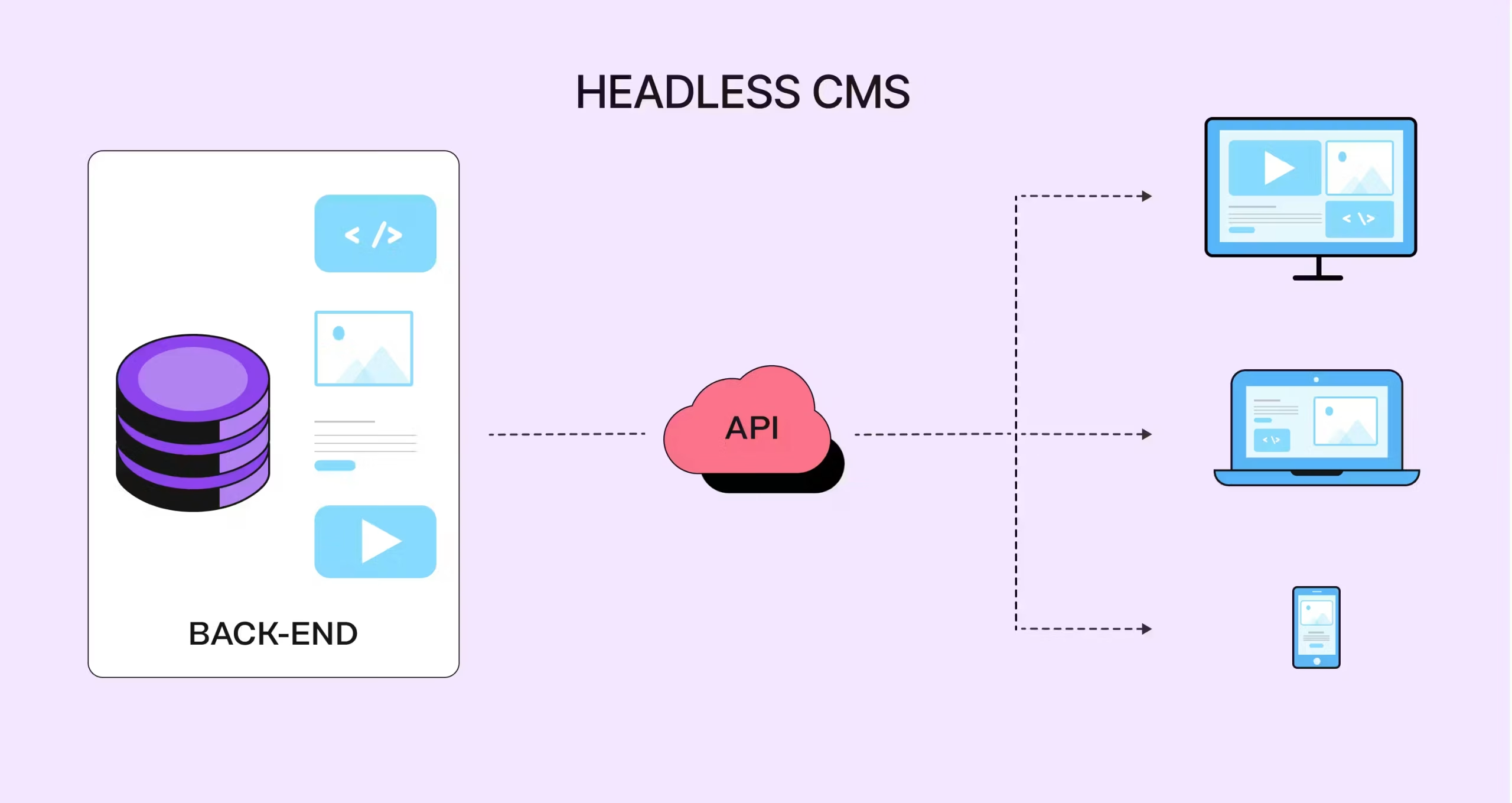
A headless CMS separates the content repository from the presentation layer entirely. The backend stores and organizes content in a structured format, and that content is then delivered via APIs to whatever frontend or device needs it. The “head,” meaning the display layer, is removed from the equation on the backend side. This means your development team can build a React-based web app, a native iOS application, and a voice interface all pulling from the same content source without duplicating data entry or managing multiple disconnected systems.
Why Decoupling Changes Everything for Growth
When a business scales, its content needs multiply. A company that starts with a single product blog might evolve into a brand with multiple regional microsites, an e-commerce storefront, a mobile app, a partner portal, and a content hub all running simultaneously. In a traditional system, each of those channels might require its own installation, its own database, its own set of templates. Maintenance becomes exponentially more complex.
With a headless architecture, the content layer remains centralized. Your marketing team edits a product description once, and it propagates to every channel that pulls from that content source. Version control becomes cleaner. Brand consistency becomes easier to enforce. And when a new channel emerges, whether that’s augmented reality, a new social commerce platform, or a regional app, connecting it is a matter of building a new frontend that calls the existing API rather than rebuilding the entire content infrastructure.
The Scalability Advantages That Matter Most
Performance at High Traffic Volumes
One of the most practical benefits of headless CMS for growing businesses is the performance gains that come from modern frontend delivery methods. Because the frontend is decoupled, developers can deploy it as a statically generated site or a server-side rendered application through platforms designed for speed and global distribution. Content can be cached at edge nodes around the world, meaning a user in Tokyo and a user in Toronto both experience fast load times without the backend spinning up resources for every single request.
For businesses running product launches, seasonal campaigns, or media events where traffic spikes unpredictably, this architecture handles surges far more gracefully than traditional setups. There’s no single server struggling to generate and serve pages dynamically under load. The static or edge-cached delivery absorbs the spike, and the CMS backend remains stable because it’s not responsible for page rendering.
Developer Flexibility and Technology Freedom
Growing businesses often find that their technology needs outpace what a rigid platform allows. With a headless CMS, your development team is not locked into the templating language, the plugin ecosystem, or the frontend framework dictated by a monolithic platform. They can choose the tools best suited for the job, whether that’s Next.js, Gatsby, Nuxt, Svelte, or any other modern framework.
This freedom has a direct impact on hiring and team scalability too. Rather than needing specialists in a proprietary system, you can hire frontend developers who work with widely adopted languages and frameworks. Onboarding is faster, knowledge transfer is smoother, and your team can move quickly when priorities shift. For companies going through rapid growth phases, that agility is invaluable.
Omnichannel Content Delivery Without Redundancy
Modern customers interact with brands across multiple touchpoints before making a decision. They might discover a product through a social media post, research it through a mobile app, compare options on a desktop browser, and complete a purchase through a voice assistant or a smart TV interface. Expecting your content team to manually manage separate versions of that content across all those channels is neither efficient nor scalable.
A headless CMS solves this by treating content as structured data rather than formatted output. Each piece of content is written once, structured with meaningful fields and relationships, and then consumed by each frontend in whatever format it needs. A headline might display as large bold text on the web, as a spoken sentence through a voice interface, and as a push notification teaser on mobile, all driven by the same content entry in the backend. That single-source-of-truth approach is what makes true omnichannel delivery achievable without overwhelming your content team.
How Businesses Actually Use Headless CMS to Scale
E-Commerce Operations Growing Across Regions
A retail brand expanding from a single country to multiple international markets faces a content challenge that quickly becomes unmanageable with traditional systems. Product descriptions need localization. Pricing and promotions vary by region. Legal disclaimers differ by market. A headless approach lets the brand maintain a single product catalog while building localization layers on top of it, delivering region-specific content to region-specific frontends without fragmenting the core data.
Inventory data, product imagery, sizing guides, and promotional copy all live in a structured content model. Regional marketing teams can manage their localized content within that model without stepping on each other’s work or risking content drift between markets.
Media Companies Managing Content at Volume
Publishers and media organizations live and die by their ability to get content out quickly across multiple formats. A breaking news article needs to appear on the website, push a notification to the app, populate a newsletter digest, and surface in a smart speaker briefing, all within minutes. A headless CMS with a well-designed content model and API infrastructure makes that workflow achievable without custom integrations that require engineering attention every time a new delivery channel appears.
Over time, as the media company grows its content library into the millions of articles, the ability to tag, categorize, relate, and retrieve content through APIs rather than database queries tied to a rigid frontend becomes a serious operational advantage. Editorial teams work in a clean interface focused on content, while technology teams maintain frontend experiences independently.
Software businesses often underestimate how quickly their documentation and support content scales. A product that starts with thirty help articles can evolve into thousands of pages covering multiple product versions, multiple user roles, multiple languages, and multiple integration scenarios. Managing that volume through a traditional CMS often results in content sprawl, broken internal links, and inconsistent formatting.
A headless CMS with structured content models and relationship fields keeps documentation organized at scale. Content can be reused across multiple documentation portals for different products. Updates to shared components like authentication guides or billing documentation propagate everywhere they’re referenced, eliminating the tedious process of hunting down every place a piece of content appears.
The Role of Content Modeling in Scalable Growth
One aspect of headless CMS that rarely gets enough attention in high-level discussions is content modeling. The power of a headless system is only as strong as the thought that went into structuring the content within it. Poorly designed content models create the same chaos at scale that traditional systems do, just in a different format.
Effective content modeling involves thinking about content as reusable components rather than pages. Instead of creating a “product page,” you create a product entry with fields for name, description, features list, imagery, pricing, related products, and localization metadata. That entry can then be assembled into a page, embedded in a comparison tool, surfaced in a search result, or included in a newsletter, all without the content team doing anything beyond the original entry.
Businesses that invest time in content modeling before implementation tend to scale far more smoothly than those that import their existing content structure without rethinking it. The upfront architecture work pays compounding dividends as the content library and delivery channels grow.
Integration Capabilities That Support Scaling Operations
A headless CMS doesn’t operate in isolation within a growing business. It connects to CRM platforms, e-commerce engines, marketing automation tools, analytics systems, personalization engines, and search infrastructure. Because the architecture is API-first, those integrations are more straightforward to build and maintain than with systems that require plugin compatibility or version locking.
When a business adds a new marketing tool or replaces its e-commerce platform, the content layer doesn’t need to change. The new system simply connects to the same APIs that the old one used. This modularity means technology decisions can be made based on what’s best for each function rather than what a single monolithic platform supports.
Key integration scenarios that benefit headless architecture include:
Personalization engines that pull content variants based on user segments without requiring template changes
Search platforms that index structured content fields for more precise and relevant results
Analytics tools that track content performance across every channel from a single data layer
Commerce platforms that combine transactional logic with editorial content for richer shopping experiences
Translation management systems that extract content fields, route them for localization, and push approved translations back into the content model automatically
Frequently Asked Questions
Is a headless CMS suitable for small businesses, or is it only for enterprise-scale operations?
Headless CMS can absolutely work for smaller businesses, but the ROI becomes most compelling when you’re managing content across multiple channels or anticipate significant growth. For a business with a single simple website and no plans to expand to other digital touchpoints, a traditional CMS may meet your needs more cost-effectively. The sweet spot for headless adoption tends to be businesses that are growing quickly, operating in multiple markets, or delivering content to audiences beyond just a website.
How does content editing experience differ in a headless CMS compared to what editors are used to?
This is a common concern, and it’s a fair one. Traditional systems often provide a visual editor where content creators can see roughly how content will appear on the page as they type. In a headless CMS, editors work in a more structured interface with defined fields rather than a free-form page editor. Many modern headless platforms have invested heavily in editorial experience, offering preview capabilities, drag-and-drop interfaces, and visual editing tools that reduce the learning curve. The transition requires some adjustment, but most editorial teams adapt quickly and often prefer the cleaner, more structured workflow.
What’s the difference between a headless CMS and a traditional CMS with an API?
Some traditional platforms have added API capabilities to give them headless-like functionality, often called a “hybrid” or “API-enabled” approach. The distinction matters because a system built from the ground up as API-first handles content modeling, scalability, and multi-channel delivery more natively than one where the API was added as an afterthought. With a true headless CMS, the entire platform is designed around the assumption that content will be consumed by multiple different frontends. With a bolted-on API, you’re often working around assumptions baked into the system from its monolithic origins.
How does headless CMS handle content versioning and rollback when something goes wrong?
Most enterprise-grade headless CMS platforms include robust versioning capabilities that track every change made to content entries, allow comparison between versions, and support rollback to any prior state. Because the content and presentation layers are separate, rolling back a content change doesn’t affect the frontend deployment, and rolling back a frontend deployment doesn’t affect the content. This separation actually makes disaster recovery and change management cleaner than in systems where content and presentation are entangled.
What should businesses prioritize when evaluating headless CMS platforms for scalability?
The most important factors to evaluate include API performance and rate limits under high request volumes, the flexibility of the content modeling tools, the quality of the editorial interface for non-technical team members, native localization and internationalization support, available integrations with your existing technology stack, and the vendor’s track record with businesses at the scale you’re targeting. Pricing models also deserve careful scrutiny, as some platforms charge based on API calls or content entries in ways that can create unexpected costs as your operation scales.








Scaling a business in today’s digital environment is no longer just about hiring more people or opening new locations. It’s about building a digital foundation that can grow with you without forcing you to tear everything down and start over every few years. For companies that rely on their online presence to drive revenue, generate leads, or deliver content to global audiences, the underlying technology stack matters enormously. This is exactly where the architecture behind how content is stored, managed, and delivered becomes a competitive advantage. Businesses that invest in thoughtful website design and development from the ground up tend to outpace those that bolt on solutions reactively, because they’ve built systems capable of bending without breaking as demands increase.
Traditional content management systems served businesses well for a long time, and many still do for simpler use cases. But as customer expectations evolved, as brands needed to publish content across mobile apps, smart displays, IoT devices, voice assistants, and web platforms simultaneously, the limitations of tightly coupled systems became impossible to ignore. That’s when the conversation around headless architecture started picking up serious momentum, and businesses across industries began rethinking what it actually means to manage content at scale.
Understanding the Core Architecture
To appreciate why headless CMS is such a powerful tool for scaling, it helps to understand what makes it structurally different from traditional systems. In a conventional CMS, the backend where content lives and the frontend where content is displayed are deeply intertwined. The system manages everything from storing a blog post to deciding how that blog post looks when a visitor lands on the page. That tight coupling creates efficiency for small operations, but it also creates a ceiling.
A headless CMS separates the content repository from the presentation layer entirely. The backend stores and organizes content in a structured format, and that content is then delivered via APIs to whatever frontend or device needs it. The “head,” meaning the display layer, is removed from the equation on the backend side. This means your development team can build a React-based web app, a native iOS application, and a voice interface all pulling from the same content source without duplicating data entry or managing multiple disconnected systems.
Why Decoupling Changes Everything for Growth
When a business scales, its content needs multiply. A company that starts with a single product blog might evolve into a brand with multiple regional microsites, an e-commerce storefront, a mobile app, a partner portal, and a content hub all running simultaneously. In a traditional system, each of those channels might require its own installation, its own database, its own set of templates. Maintenance becomes exponentially more complex.
With a headless architecture, the content layer remains centralized. Your marketing team edits a product description once, and it propagates to every channel that pulls from that content source. Version control becomes cleaner. Brand consistency becomes easier to enforce. And when a new channel emerges, whether that’s augmented reality, a new social commerce platform, or a regional app, connecting it is a matter of building a new frontend that calls the existing API rather than rebuilding the entire content infrastructure.
The Scalability Advantages That Matter Most
Performance at High Traffic Volumes
One of the most practical benefits of headless CMS for growing businesses is the performance gains that come from modern frontend delivery methods. Because the frontend is decoupled, developers can deploy it as a statically generated site or a server-side rendered application through platforms designed for speed and global distribution. Content can be cached at edge nodes around the world, meaning a user in Tokyo and a user in Toronto both experience fast load times without the backend spinning up resources for every single request.
For businesses running product launches, seasonal campaigns, or media events where traffic spikes unpredictably, this architecture handles surges far more gracefully than traditional setups. There’s no single server struggling to generate and serve pages dynamically under load. The static or edge-cached delivery absorbs the spike, and the CMS backend remains stable because it’s not responsible for page rendering.
Developer Flexibility and Technology Freedom
Growing businesses often find that their technology needs outpace what a rigid platform allows. With a headless CMS, your development team is not locked into the templating language, the plugin ecosystem, or the frontend framework dictated by a monolithic platform. They can choose the tools best suited for the job, whether that’s Next.js, Gatsby, Nuxt, Svelte, or any other modern framework.
This freedom has a direct impact on hiring and team scalability too. Rather than needing specialists in a proprietary system, you can hire frontend developers who work with widely adopted languages and frameworks. Onboarding is faster, knowledge transfer is smoother, and your team can move quickly when priorities shift. For companies going through rapid growth phases, that agility is invaluable.
Omnichannel Content Delivery Without Redundancy
Modern customers interact with brands across multiple touchpoints before making a decision. They might discover a product through a social media post, research it through a mobile app, compare options on a desktop browser, and complete a purchase through a voice assistant or a smart TV interface. Expecting your content team to manually manage separate versions of that content across all those channels is neither efficient nor scalable.
A headless CMS solves this by treating content as structured data rather than formatted output. Each piece of content is written once, structured with meaningful fields and relationships, and then consumed by each frontend in whatever format it needs. A headline might display as large bold text on the web, as a spoken sentence through a voice interface, and as a push notification teaser on mobile, all driven by the same content entry in the backend. That single-source-of-truth approach is what makes true omnichannel delivery achievable without overwhelming your content team.
How Businesses Actually Use Headless CMS to Scale
E-Commerce Operations Growing Across Regions
A retail brand expanding from a single country to multiple international markets faces a content challenge that quickly becomes unmanageable with traditional systems. Product descriptions need localization. Pricing and promotions vary by region. Legal disclaimers differ by market. A headless approach lets the brand maintain a single product catalog while building localization layers on top of it, delivering region-specific content to region-specific frontends without fragmenting the core data.
Inventory data, product imagery, sizing guides, and promotional copy all live in a structured content model. Regional marketing teams can manage their localized content within that model without stepping on each other’s work or risking content drift between markets.
Media Companies Managing Content at Volume
Publishers and media organizations live and die by their ability to get content out quickly across multiple formats. A breaking news article needs to appear on the website, push a notification to the app, populate a newsletter digest, and surface in a smart speaker briefing, all within minutes. A headless CMS with a well-designed content model and API infrastructure makes that workflow achievable without custom integrations that require engineering attention every time a new delivery channel appears.
Over time, as the media company grows its content library into the millions of articles, the ability to tag, categorize, relate, and retrieve content through APIs rather than database queries tied to a rigid frontend becomes a serious operational advantage. Editorial teams work in a clean interface focused on content, while technology teams maintain frontend experiences independently.
SaaS Companies Running Customer-Facing Documentation
Software businesses often underestimate how quickly their documentation and support content scales. A product that starts with thirty help articles can evolve into thousands of pages covering multiple product versions, multiple user roles, multiple languages, and multiple integration scenarios. Managing that volume through a traditional CMS often results in content sprawl, broken internal links, and inconsistent formatting.
A headless CMS with structured content models and relationship fields keeps documentation organized at scale. Content can be reused across multiple documentation portals for different products. Updates to shared components like authentication guides or billing documentation propagate everywhere they’re referenced, eliminating the tedious process of hunting down every place a piece of content appears.
The Role of Content Modeling in Scalable Growth
One aspect of headless CMS that rarely gets enough attention in high-level discussions is content modeling. The power of a headless system is only as strong as the thought that went into structuring the content within it. Poorly designed content models create the same chaos at scale that traditional systems do, just in a different format.
Effective content modeling involves thinking about content as reusable components rather than pages. Instead of creating a “product page,” you create a product entry with fields for name, description, features list, imagery, pricing, related products, and localization metadata. That entry can then be assembled into a page, embedded in a comparison tool, surfaced in a search result, or included in a newsletter, all without the content team doing anything beyond the original entry.
Businesses that invest time in content modeling before implementation tend to scale far more smoothly than those that import their existing content structure without rethinking it. The upfront architecture work pays compounding dividends as the content library and delivery channels grow.
Integration Capabilities That Support Scaling Operations
A headless CMS doesn’t operate in isolation within a growing business. It connects to CRM platforms, e-commerce engines, marketing automation tools, analytics systems, personalization engines, and search infrastructure. Because the architecture is API-first, those integrations are more straightforward to build and maintain than with systems that require plugin compatibility or version locking.
When a business adds a new marketing tool or replaces its e-commerce platform, the content layer doesn’t need to change. The new system simply connects to the same APIs that the old one used. This modularity means technology decisions can be made based on what’s best for each function rather than what a single monolithic platform supports.
Key integration scenarios that benefit headless architecture include:
Frequently Asked Questions
Is a headless CMS suitable for small businesses, or is it only for enterprise-scale operations?
Headless CMS can absolutely work for smaller businesses, but the ROI becomes most compelling when you’re managing content across multiple channels or anticipate significant growth. For a business with a single simple website and no plans to expand to other digital touchpoints, a traditional CMS may meet your needs more cost-effectively. The sweet spot for headless adoption tends to be businesses that are growing quickly, operating in multiple markets, or delivering content to audiences beyond just a website.
How does content editing experience differ in a headless CMS compared to what editors are used to?
This is a common concern, and it’s a fair one. Traditional systems often provide a visual editor where content creators can see roughly how content will appear on the page as they type. In a headless CMS, editors work in a more structured interface with defined fields rather than a free-form page editor. Many modern headless platforms have invested heavily in editorial experience, offering preview capabilities, drag-and-drop interfaces, and visual editing tools that reduce the learning curve. The transition requires some adjustment, but most editorial teams adapt quickly and often prefer the cleaner, more structured workflow.
What’s the difference between a headless CMS and a traditional CMS with an API?
Some traditional platforms have added API capabilities to give them headless-like functionality, often called a “hybrid” or “API-enabled” approach. The distinction matters because a system built from the ground up as API-first handles content modeling, scalability, and multi-channel delivery more natively than one where the API was added as an afterthought. With a true headless CMS, the entire platform is designed around the assumption that content will be consumed by multiple different frontends. With a bolted-on API, you’re often working around assumptions baked into the system from its monolithic origins.
How does headless CMS handle content versioning and rollback when something goes wrong?
Most enterprise-grade headless CMS platforms include robust versioning capabilities that track every change made to content entries, allow comparison between versions, and support rollback to any prior state. Because the content and presentation layers are separate, rolling back a content change doesn’t affect the frontend deployment, and rolling back a frontend deployment doesn’t affect the content. This separation actually makes disaster recovery and change management cleaner than in systems where content and presentation are entangled.
What should businesses prioritize when evaluating headless CMS platforms for scalability?
The most important factors to evaluate include API performance and rate limits under high request volumes, the flexibility of the content modeling tools, the quality of the editorial interface for non-technical team members, native localization and internationalization support, available integrations with your existing technology stack, and the vendor’s track record with businesses at the scale you’re targeting. Pricing models also deserve careful scrutiny, as some platforms charge based on API calls or content entries in ways that can create unexpected costs as your operation scales.